
Pond Cleaning & Maintenance in Hitchin
Wildlife-friendly pond care for garden, koi and natural ponds across Hitchin, Letchworth, Baldock, Stevenage, Knebworth and Royston. Over 30 years’ combined experience, plus Froglife Corporate Sponsor status.
Send photos of your pond and your address, and we’ll reply with a clear quote, usually within a day.
CONTACT US
Pond cleaning that looks after the whole pond
Which service do you need?
Your pond | What you need | Price |
Thick silt, bad smell, hasn’t been cleaned in years | Full clean (drain, vacuum, pressure wash, equipment service) | From £250 small · £350 medium · £600 large |
Mostly fine, but silt is building up on the bottom | Pond hoovering (silt removed without draining) | Quoted from photos |
Healthy pond you’d like kept that way | Maintenance plan | Visits from £125 |
Losing water, or a pump or filter has failed | Repair or call-out | Call-outs from £165 |
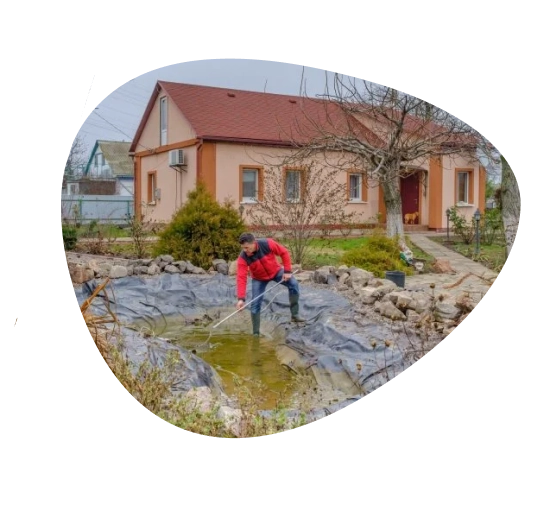
How a full clean works
- Fish and wildlife moved to a large aerated holding tank
- Plants lifted and kept safe
- Pond drained
- Liner pressure washed and silt vacuumed out
- Excess vegetation thinned, keeping enough to balance the water
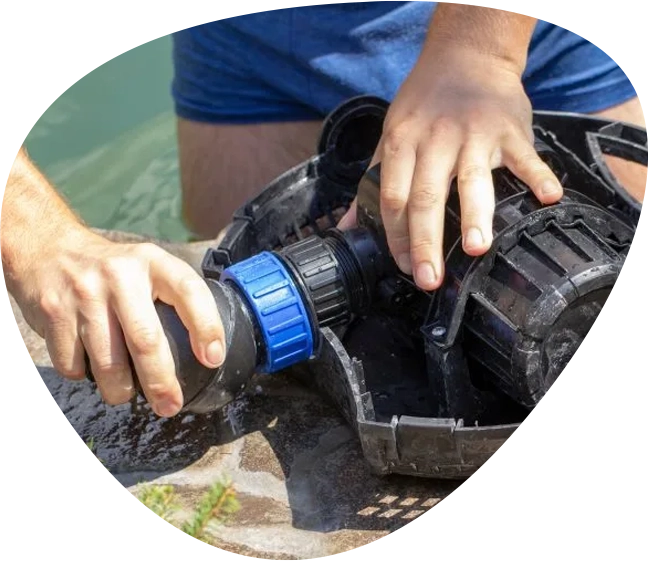
- Pump, filter and UV unit stripped down and cleaned
- UV bulb changed and quartz sleeve cleaned, if needed
- Leaks and small holes checked and repaired
- Refilled with your own pond water topped up with tap water, treated with dechlorinator
- Filter bacteria added, system restarted
- Plants, fish and wildlife returned
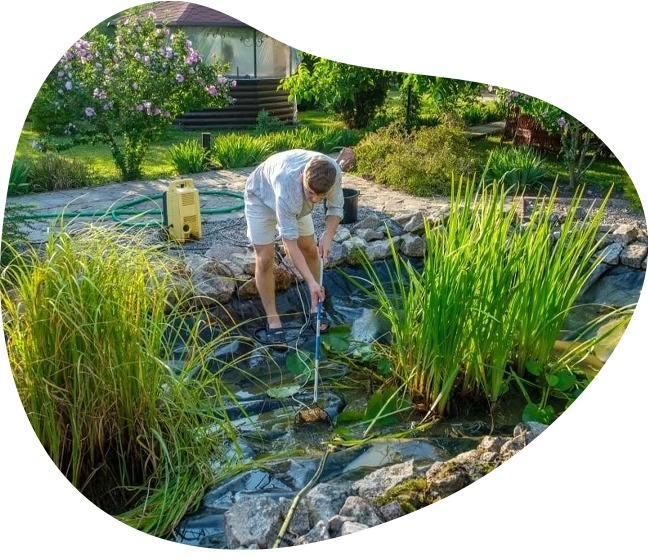
Keeping a planted or wildlife pond healthy
- Don’t strip the plants. Oxygenators and marginals absorb the nutrients algae feed on. Thin them, don’t clear them.
- Clean in stages if the pond is very overgrown. Taking everything out at once often turns clear water green.
- Time it right. Confirm with Anthony: autumn is usually the kindest time for a full clean of a wildlife pond, after tadpoles have left and before frogs settle in to overwinter. Spring cleans risk disturbing spawn.
- Net the leaves in autumn. Rotting leaves are the main cause of silt in Hertfordshire gardens.
- Keep some shallows. A gently sloping edge lets frogs, newts and hedgehogs get in and out.
Maintenance plans in Hitchin
- Gold: 6 visits a year (2 seasonal + 4 maintenance). Total peace of mind
- Silver: 4 visits a year (2 seasonal + 2 maintenance). Less work, with some DIY
- Bronze: 2 visits a year. Light-touch yearly care
Repairs, equipment and koi
- Leaks and liners: we find the source and repair or replace. See pond liner replacement .
- Pumps, filters and UV units: Oase equipment supplied and fitted. See pond equipment .
- Koi ponds: regular water testing and careful fish handling.
- Water features and pond builds: see water features .
Why Hitchin pond owners choose Aqua Pond
- Over 30 years’ combined experience in pond care and water chemistry
- Wildlife and plants protected on every job
- Froglife Corporate Sponsor
- Oase equipment and eco-friendly methods
- 5-star rated on Google
- Public liability insured
- Reply within a day, and a written quote before any work
Areas we cover near Hitchin
Hitchin, Letchworth Garden City, Baldock, Stevenage, Knebworth, Royston, Ickleford, Pirton, Offley, Codicote, Whitwell. See all areas we cover , or visit our Stevenage and Hertfordshire pages.
Autumn: the best time to book
Autumn is the kindest time to clean a wildlife or planted pond, and the best time to get any pond ready for winter. Net the leaves, clear the silt, service the filter and your pond will come through to spring clear. We’re busiest from March to November, so book early.
Frequently asked questions
Get your free pond quote
MY POND IS OVERGROWN.
If you have a small pool and the plants have not been managed for a number of years, you can simply cut them back or pull some of them out. You do have to be careful however as very often these pools have good water quality because the plants are absorbing the nutrients. The key thing then, is not to rip out too many of the plants because you can go from clear, relatively nice-looking water to something full of algae, simply because you have pulled too many of the plants out.
If you have a much bigger pond, a lake or a lochan then commonly some of the problems are with some of the very vigorous plants like bulrush or Norfolk reed and these need spraying off, and that is the best way to control them. Ideally you do not plant Typha (bulrush) or Norfolk reed in ornamental systems simply because they tend to take over completely. There is also a small-leafed lily called Nymphoides peltata which you have to avoid like the plague and these all need spraying in order to control them.
MY POND IS LEAKING – WHAT CAN I DO?
Probably the commonest problem that we get approached with is a pond that is leaking and there are various steps you can take to diagnose what’s going on
- If you have a pump and a stream or waterfall and the pond is going down, turn the pump off and the fill the pond up. If you do not get any water loss then, it means that the problem is either in the hose from the pump to the top of the water course, or in the water course, which is actually the commonest cause. If it is in the water course, put the pump back on and see if you can see anywhere where the water is actually leaking out the sides either over a liner or through concrete or whatever. Once you locate it, you can fix it.
- The other thing that can happen is simply debris accumulating in narrow points in the stream or cascade backing the water up behind it and it then flowing out the sides, and you lose water that way.
- Assuming you have not got a water course, or that the leak is not there, then the other obvious problem is a hole in the liner. Again, if you do not fill the pond up and let the pond drop, it will eventually drop to where the hole is, you can then find it and potentially patch it.
- One other cause of ponds going down is a liner that is behind stones or something, somebody stands on the stone, pushes the liner down and the water runs out over the top of a new low point and you end up with what looks like a leak. If you can locate that, just pull the liner back up and you will not have a leak any more
WHY IS MY POND WATER GREEN?
There may be a number of reasons why your pond is so green. First of all, you may have too small of a pump or filter for the size of your pond. Secondly, your pond may be in full sun which creates a perfect environment for algae blooms, or the pond is very shallow, particularly around the edges and doesn’t get much water circulation. You can remedy these things by first checking your pump and filter size for your pond. If it is in full sun, you will have to increase the size of the filter and pump to compensate for the increased algae blooms that will occur in full sun. If you recently made a water exchange or filled your pond within a few weeks, you may need to be patient as your pond hasn’t found it’s ecological balance yet. If it’s a brand new pond, I would recommend waiting at least 4-6 weeks for your pond to find it’s balance. Hold off on any chemicals. Add some Microbe Lift which is all-natural beneficial bacteria and organic barley straw bales to your pond. This increases the function of your biological filter and combats algae blooms including string algae. Every pond should have them.
One point to note, is that you must be equipped with a large enough pump, filter and biological media for the beneficial bacteria to grow on and be patient and allow the pond to find it’s natural ecological system. You want to try to correct the problem instead of needing to add chemicals to it all the time. Another thing that could be adding to your algae blooms is the frequent addition of cold tap water to your pond. Whenever you add cold tap water to your pond and the pond is in the heat of full sun, it creates a great environment for algae to increase. Try to eliminate adding tap water to your pond and you just may reduce the algae. Every time you add tap water, your pond has to adjust and find it’s eco-balance. If you’re continually adding more water to your pond, your pond will never really balance itself and you’ll try to combat algae and ammonia levels all the time. In either of these situations, get at the root of the problem whether it’s the wrong pump or filter size or the addition of cold tap water and see if it doesn’t correct itself. If you’re having a problem with this and need some advise, contact us and we’ll be happy to assist you. If you need to add tap water, run the water through some Super Activated Filter Carbon to take out the chlorine and chloramine and add more beneficial bacteria to it afterwards.
Do I need to have my pumps running all the time?
Pumps give your pond water circulation. If they are the right size for your pond and are properly placed, they eliminate stagnant water and provide oxygen to your pond. If they are connected or pumped to a filter, you reduce the effectiveness of the filter if your pump is not on and may end up having unsightly water and elevated levels of ammonia providing you have fish. If you have multiple pumps, you most likely may not need to have all of them running as long as you have at least 1/2 the total gallons of your pond pumped every hour (there is a different formula for very large ponds – contact us and we will assist you in calculating proper aeration for your pond) for good water circulation. So, as long as you have good circulation and enough oxygen in your pond, you don’t necessarily need to have all of your pumps running all of the time.